.png)
Pax Museum Gallery
C-130 Preflight Painting
Photo TBD
Details: This painting was painted by Mark Romanowitz and donated to TCVA by the artist. It shows a typical pre-flight and preparation for a TACAMO mission.
TACAMO C-130 Yoke Medallion
Details: A medallion that was mounted to both pilot yokes on the flight deck. Because of their rarity, they were coveted by many. But, by the time the airplanes arrived from their outfitting in Dallas, they were almost always missing upon delivery to the squadrons. TCVA is fortunate to have an original in its collection. As a memento, TCVA got permission from Lockheed to make replicas and sold them in its store.

Radar Scope
Photo TBD
Details: The visual readout from the APN-59 weather RADAR system on the C-130. This scope sat on the “dashboard” of the flight deck for the pilots and flight engineer to have a long range view of weather and other aircraft in the vicinity.
60/90 KVA Generator Control Panel

Details: Unique to a TACAMO C-130, the 60/90 Control Panel controlled the additional generators (on each engine) necessary to power the 200KW VLF Power Amplifier.
Drogue
Details: The drogue was essentially an anchor that provided stable aerodynamics to the 5 miles of antenna wire. Its unique look and function for TACAMO made it a perfect choice for TCVA’s emblem.

Guillotine Switches
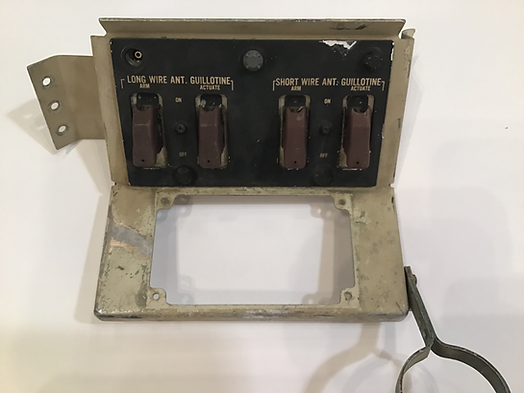
Details: Unique to TACAMO, these switches were placed within reach of the pilot and the Reel Operator to enable them to sever the antenna wires in the event of an in-flight emergency.
Navigator’s Station
Photo TBD
Details: An actual size photo of some of the instruments used by the navigator to locate their present position and direct the pilots to their destination.
Navigator's Seat

Details:
Identical to the other seats on the C-130, Pilot, Co-pilot, Flight Engineer, 4 in Comm Central and the Reel Operator. This particular seat was salvaged from BUNO 159348, which is on display in Herc Park next to STRATCOMMWING-1 headquarters at Tinker AFB in Oklahoma City. The seat was present to the Wing Commander at the time, Capt. Vern Lochausen, who had arranged for 159348 to be put “on sticks” for display. Vern was one of many crew members who had countless hours in that very seat. Vern is currently the President and Historian of the TCVA and has donated the seat to our museum exhibit.
Sextant

Details: A navigation device that mounted to the aircraft, just above the Navigators station. It penetrated the fuselage and allowed the navigator to locate stars and determine the aircraft’s location relative to them.
A common prank used on new crew navigators was to rub brake dust on the eyepiece to leave a black smudge around the eye of the victim, which wasn’t discovered until they looked in the mirror.
ACO Box (ca. 1968)

The ACO Box
Comm Central Plaque
Details: This plaque was mounted in the TACAMO C-130 to illustrate what and where much of the communications system was. Most of the equipment was pretty “high-tech” for its time, the mid 1960’s.
The equipment ranged from:
-
High Frequency (HF) radios
-
Satellite communication
-
Low Frequency (LF) reception
-
Very Low Frequency reception and transmission
-
Message encryption/decryption
-
Message flow control

Teletype

Details:
Long before email, the teletype was the keyboard/printer that transcribed text based messages via High Frequency radio. It was our primary connection to CINCLANT/CINCPAC to receive EAMs (Emergency Action Messages) that TACAMO would relay to the submerged submarines.
CW Keys

Details: Communication device that enabled the Radioman to send Morse Code through HF radios and the VLF Power Amplifier. The examples to the left show several different varieties used by individuals. Each key had its own “feel” about it which was reflected in its “speed” along with the skill of the operator.
Variometer
Details: One of 5 variometers in the RFPA (Radio Frequency Power Amplifier). These controlled coils adjusted automatically to maintain optimal impedance matching for the 5 miles of antenna wire. This control increased the radio wave propagation and reduced reflected power back into the RFPA as the aircraft flew its 1 mile orbit with a helix of wire flying behind.

Tetrode Tubes and Ironman

Details: Two tetrode vacuum tubes that amplified the frequency shift keyed signal to about 200KW that was applied to the Short Trailing Wire Antenna. Working with the neutral Long Wire Antenna as a reflector to magnify the radio signal at VLF frequencies that are carried around the world. The “Ironman” was the container around tetrode tubes that had distilled/deionized water circulated through a heat exchanger to remove the heat created by the tubes.
Lightning Arrester

Details: A device installed on all external antennas to isolate the antennas from the radio itself. In the event that lightning might strike the antenna wire, it would protect the radio from the enormous surge of energy from the lightning.
Life Vest

Details Coming Soon
Medical Bag

Details Coming Soon
C-130 Ash Trays

Details: Back in the day, when smoking was permitted on the aircraft, these were the “butt & ash” receptacle.
Donated by Buff Crowell
Green Flight Suit
Details: This flight suit was worn by CDR Mike Duval and donated to TCVA by his family. Mike is a member of the TACAMO Hall of Fame. This green Nomex flight suit is typical of nearly all military flight suits.
Photo TBD
Blue Flight Suit
Details: This flight suit was worn by and donated to TCVA by AVCM Mike Kemp. Mike is a member of the TACAMO Hall of Fame. The unique blue color was to designate that it was for an E-6 crew. During the transition from the EC-130/Q to the E-6/A, the two different colors of flight suits helped distinguish one platform crew from the other.
Photo TBD
Flight Jacket
Photo TBD
Details: This flight jacket was worn by LCDR Bill “Buff” Crowell and on loan to TCVA for this exhibit from his family.
Left Mannequin
Photo TBD
Details: Displayed here is the flight jacket of CDR Bob Downey. Long time TACAMO veteran and CO (Commanding Officer) of VQ-4. Unique about this artifact is the NFO (Naval Flight Officer) wings on the hat. They are the older style wings, from the 1950’s.
Right Mannequin
Photo TBD
Details: Displayed here is the flight jacket worn by ADCS Gary Breeden. Gary is a member of the TACAMO Hall of Fame and was a long time C-130 Flight Engineer and a member of the “Pep Boys”. The Pep Boys were the transition team of pilots and flight engineers that made the transition to the Boeing E-6 airframe and taught subsequent pilots and flight engineers. After retirement from the Navy, Gary worked for Boeing as a flight engineer for the further development of the E-6.
Hotel Room Keys
Details:
“Here & There”
The Belvedere was the local hotel in Lexington Park where many sailors and families transitioned in and out of NAS Patuxent River.
The “Bird in Hand” key is a souvenir from the hotel that crews frequently stayed at in Mildenhall, England.

890 Crash
Details: Status: Final
Date: Saturday 15 January 1972
Type: Silhouette image of generic C130 model; specific model in this crash may look slightly different
Lockheed EC-130G Hercules
Operator: United States Navy
Registration: 151890
MSN: 3871
First flight: 1963
Crew: Fatalities: 0 / Occupants:
Passengers: Fatalities: 0 / Occupants:
Total: Fatalities: 0 / Occupants:
Aircraft damage: Damaged beyond repair
Location: near Patuxent River-NAS, MD (NHK) ( United States of America)
Phase: En route (ENR)
Nature: Military
Departure airport: Patuxent River NAS, MD (NHK/KNHK), United States of AmericaDestination airport: ?

Narrative:
Navy Hercules 151890 had flown for over three months with a maintenance discrepancy on the number one fuel tank quantity indicator. Before the mishap flight, another attempt was made to repair the solder connections in the cannon plug. Maintenance personnel were unable to satisfactorily complete the repair in the time available before that days flight. They hurriedly reassembled the cannon plug and verbally warned the oncoming flight engineer to leave the number one fuel tank quantity indicator system circuit breaker out to prevent the indicator motor from running and ruining the internal clutch. The aircraft then flew four flights prior to the accident. The verbal warning was passed between flight engineers, except on the fourth flight. While conducting preflight procedures the fourth flight engineer noticed the circuit breaker to be out and reset it. The circuit breaker popped within seconds and was then left out for the flight back to home field. The circuit breaker was reset by an unknown person between the time the aircraft landed and the preflight the next day by the mishap crew. Shortly after takeoff from Patuxent River-NAS, MD (NHK), while climbing through 7500 feet, an explosion occurred in the outboard part of the left wing. A fire erupted. The no. 1 engine was shut down and the extinguisher bottles fired. The crew was unable to control the fire. Control difficulties forced the pilot to carry out a forced landing. An emergency descent was flown at a speed of 270 kts IAS and a forced landing was made in a corn field. After the aircraft came to rest, the fire burned for 36 minutes. The fire continued burning aft and inboard before it was extinguished by a local volunteer fire department.
Probable Cause:
CONCLUSION: "The aircraft suffered an inflight explosion in the left wing 5 minutes after takeoff. The explosion occured in the #1 main fuel tank in the forward center area beneath the outboard access plate in the immediate vicinity of the #10 fuel quantity probe. The explosion tore open the upper forward surface of the wing from OWS 369 to OWS 576. The surface of the fuel instantly ignited into a continuous fire forcing the flight crew to complete an emergency landing in an open field 5 minutes after the explosion. The aircraft's left wing continued to burn on the ground for an additional 36 minutes. Fifteen feet of the outer left wing was consumed by the fire.
The explosion was caused by the introduction of 115 volt single phase 400 Hz power into the fuel quantity indicating system for the #1 main fuel tank. An arc occured in the fuel tank airspace from either one of two sources:
a. From the #10 fuel quantity probe to an unknown ground.
b. From the coax cable in the immediate vicinity of the #10 fuel quantity probe to an unknown ground."
Classification:
Fuel tank explosion
Forced landing outside airport
151890 Crash Axe

ECX
Photo TBD
The ECX was the prototype for the E-6. A test bed for “proof of concept” that a 4 engine jet airliner could perform the aerobatic maneuver of the tight orbit necessary for the TACAMO mission. Its success led to the further development of the E-6 that we know today.
E-6 Tail Fragment
Details: A piece of the E-6 tail that broke off in flight during a test over rural Washington State.

